
Peptides in Skincare: What Are They & What Do They Actually Do?
If you've spent any time looking at skincare recently, you've probably come across peptides.
They're increasingly found in serums, moisturisers and professional skincare, often alongside claims about collagen, firmness and healthier-looking skin. But what actually are peptides? Can they really communicate with the skin? And does seeing the word "peptide" on a product automatically mean it's going to transform your skin?
The science is much more interesting — and more nuanced — than the marketing can sometimes make it sound.
So, let's break it down.
First things first: what actually is a peptide?
To understand peptides, we need to start with amino acids.
Amino acids are small molecules that act as building blocks for proteins within the body. When amino acids join together in relatively short chains, they form peptides. Longer and more complex chains form proteins.
And proteins are rather important when we're talking about skin.
Collagen, elastin and keratin are all proteins involved in the structure and function of healthy skin. Collagen in particular provides structural support within the dermis, while elastin contributes to the skin's ability to stretch and return towards its original shape.
Peptides aren't simply tiny pieces of collagen that we apply to the face to "replace" lost collagen, though. That's an important distinction.
Some peptides can behave more like biological messengers, interacting with cellular processes and signalling pathways. This is one reason they have become such an interesting area of cosmetic science.
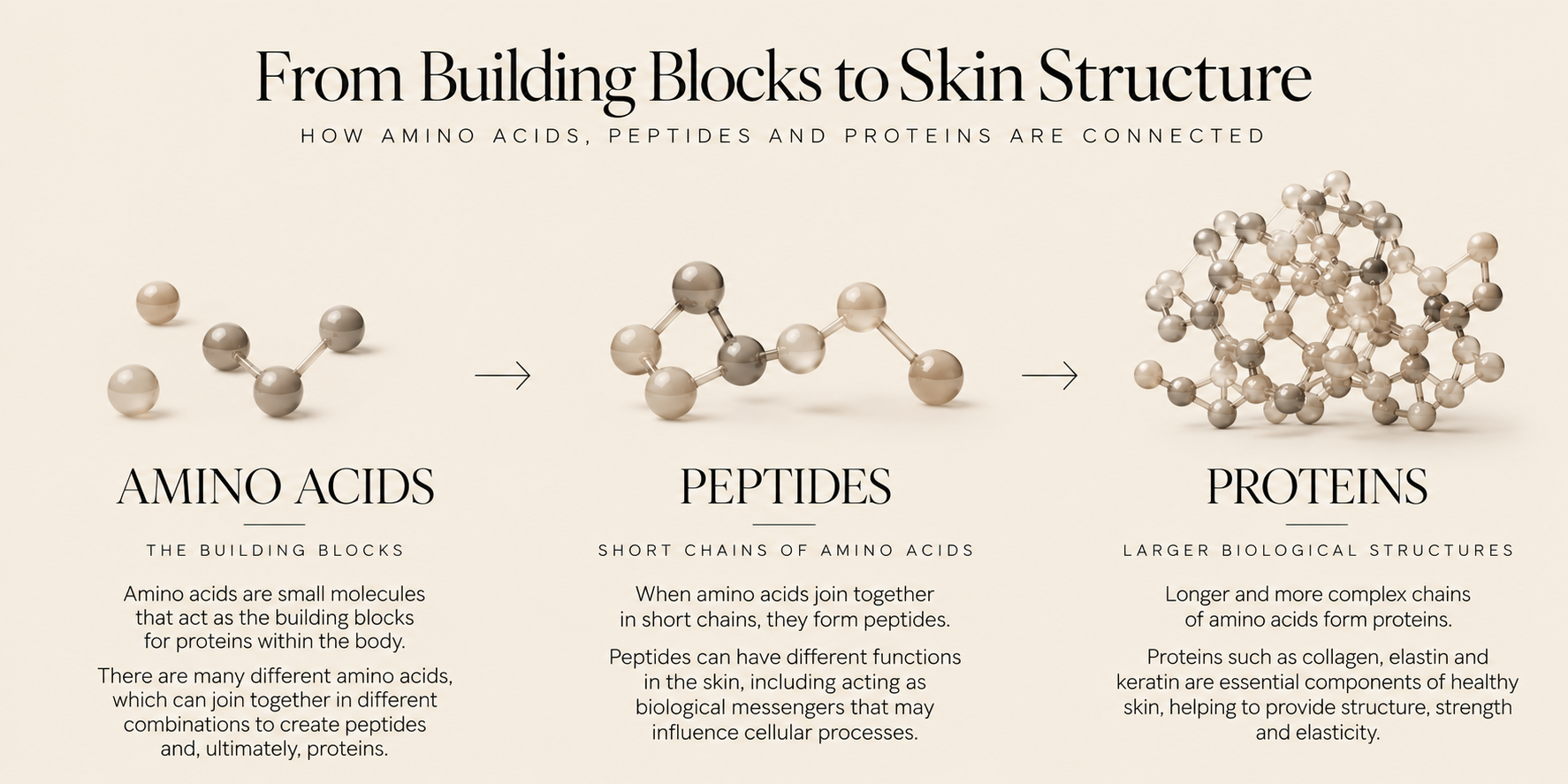
Peptides, simply explained
Amino acids are the building blocks. When they join together in short chains, they form peptides. Longer, more complex chains can form proteins — including collagen, elastin and keratin.
Think of amino acids as individual building blocks. Join several together and you can create a peptide; larger, more complex structures form proteins.
So why put peptides in skincare?
This is where things get particularly interesting.
There isn't just one ingredient called "peptide".
There are many different peptides, with different structures and proposed functions. In cosmetic science they're often grouped according to how they're intended to work, including signal peptides, carrier peptides, enzyme-inhibiting peptides and neurotransmitter-modulating peptides.
Signal peptides are especially interesting when we're talking about ageing skin.
Some are designed to mimic fragments or signals associated with proteins within the extracellular matrix. The idea is that these signals may influence cellular processes involved in maintaining that matrix — including processes associated with collagen.
Other peptides have completely different proposed roles.
Which means saying "this product contains peptides" actually tells us surprisingly little on its own.
We need to know which peptide, in which formulation, at what concentration, and whether it can reach the area of the skin where it's intended to work.
And that brings us to one of the most important parts of the conversation.
Your skin is actually very good at keeping things out
We often talk about getting ingredients "into the skin", but it's worth remembering what one of your skin's main jobs actually is:
to protect you from the outside world.
The outermost layer of the epidermis — the stratum corneum — forms an incredibly effective barrier.
It's often described using a "bricks and mortar" analogy: the corneocytes are the bricks, surrounded by a lipid-rich matrix containing substances such as ceramides, cholesterol and fatty acids.
That's brilliant for keeping unwanted substances out and limiting excessive water loss.
It's less convenient when you're trying to formulate a skincare ingredient that needs to penetrate that barrier.
Many peptides are relatively hydrophilic — meaning they have an affinity for water — while the stratum corneum is rich in lipids. Their size and molecular characteristics can therefore make penetration challenging.
This is why formulation matters so much.
Researchers continue to investigate different delivery systems and modifications that may improve peptide stability and penetration. Studies looking at individual peptides have also produced quite different penetration results depending on the peptide and formulation being tested.
The important bit
Seeing "peptides" written on a product doesn't automatically tell us whether that product will be effective.
The specific peptide, its stability, the overall formulation, the delivery system and the other ingredients surrounding it all matter.
Skincare is very rarely about one exciting ingredient working in isolation.
What about collagen?
This is probably the reason most people first become interested in peptides.
As we age, changes take place within the skin's extracellular matrix, including changes involving collagen and elastin. UV exposure and other environmental factors can also contribute significantly to the visible ageing process.
Because certain peptides may influence signalling pathways associated with extracellular-matrix components, they've attracted considerable interest within ageing-skin research.
But there is a distinction I think is really important:
Applying a peptide product is not the same thing as putting new collagen into your skin.
Collagen itself is a very large molecule and does not simply travel through the epidermal barrier and slot itself into your existing collagen network.
Peptides are interesting for a different reason: some may act as signalling molecules or influence biological pathways involved in the skin.
It's a much more complicated story than "put collagen on skin = make more collagen."
So… do peptide skincare products actually work?
The fairest answer is:
there's promising science, but we shouldn't treat every peptide claim as proven fact.
Laboratory studies and clinical studies of individual peptide ingredients and formulations have reported potentially useful effects, and peptides continue to be an active area of cosmetic and dermatological research.
However, the quality and quantity of clinical evidence varies considerably between different peptides.
One of the difficulties is that a study showing an effect from one particular peptide in one particular formulation doesn't automatically prove that every product containing a peptide will produce the same result.
More recent reviews of the research have continued to highlight issues around skin penetration, stability, formulation and the need for stronger clinical evidence.
So I don't view peptides as a miracle ingredient.
I view them as one potentially useful tool within a well-formulated skincare routine.
And that difference matters.
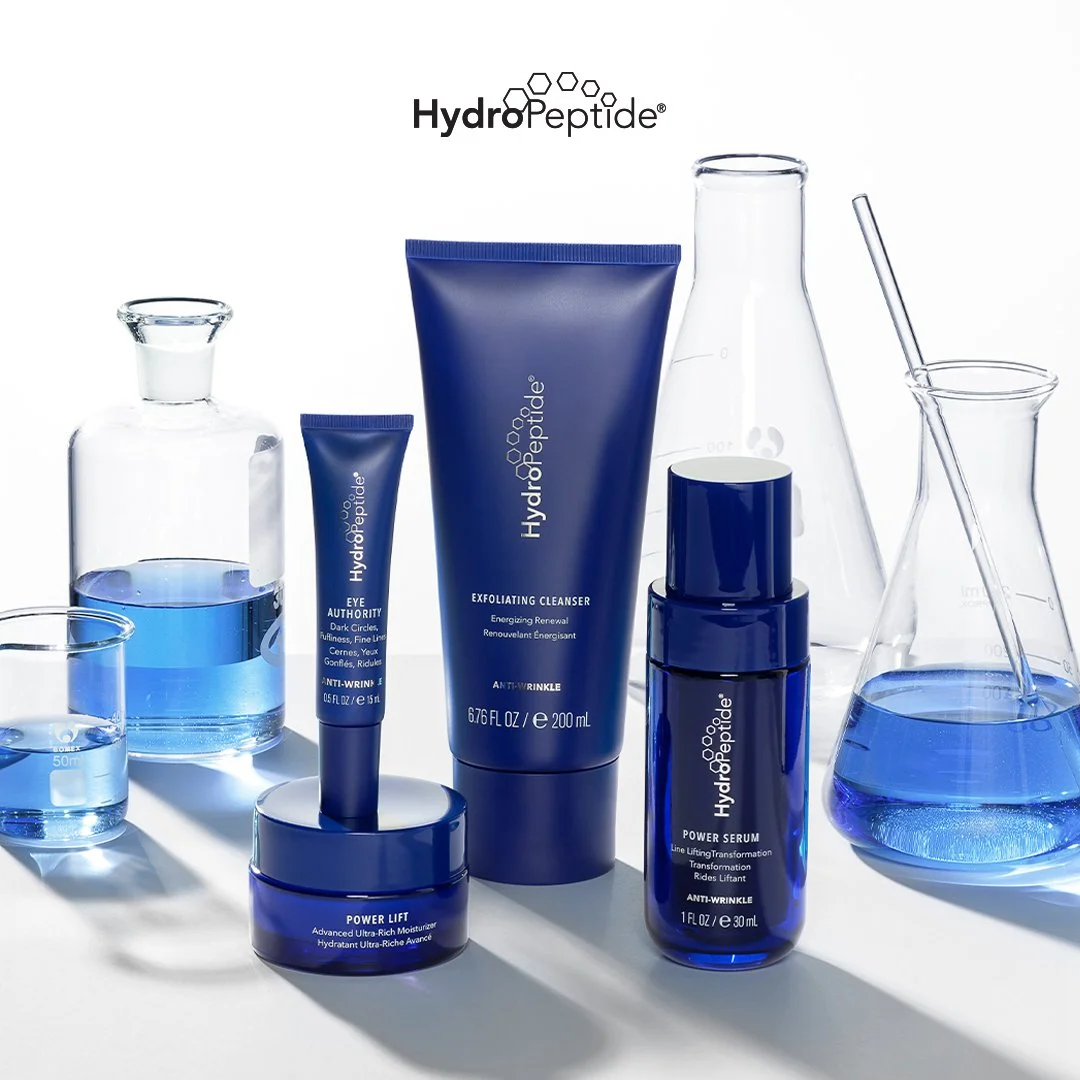
Why HydroPeptide?
Peptide science sits at the heart of HydroPeptide's professional skincare. I chose the range because it allows me to combine targeted active ingredients with a personalised, luxurious treatment experience.
So why do I use HydroPeptide at Beau.t?
This is where my choice of professional skincare becomes important.
I didn't choose HydroPeptide simply because the word peptide happens to be in the name.
I wanted a professional skincare range that allowed me to combine results-focused ingredients and modern formulation science with the relaxing, luxurious experience I still believe a facial should have.
HydroPeptide has specialised in peptide-led skincare for more than 20 years and describes its current range as using more than 65 peptide complexes across its formulations.
The brand also uses different peptide technologies rather than relying on one single peptide throughout every product.
That gives me much more flexibility when I'm building a treatment around an individual person's skin.
Different skin doesn't need the same thing
This is one of the biggest reasons I don't believe in performing exactly the same facial on every client.
One person may come to me concerned about dehydration and barrier function.
Someone else may be primarily concerned about fine lines and changes in firmness.
Another client might be struggling with uneven tone, pigmentation, breakouts or sensitivity.
Those skins don't necessarily need the same products, actives or treatment plan.
Within the HydroPeptide range, peptide technologies are combined with other established skincare ingredients depending on the formulation.
For example, Daily Drench combines HydroPeptide's CellRenew-16 peptide with different molecular weights of hyaluronic acid and other hydrating ingredients. The brand positions the formula around hydration and supporting barrier function.
Power Serum, meanwhile, contains a much larger blend of peptide complexes alongside ingredients including hyaluronic acid and antioxidants, and is formulated specifically around visible signs of ageing such as fine lines, firmness and elasticity.
That's an important point because even within one professional range, "using peptides" doesn't mean using the same product for everyone.
The whole formulation matters.
What is CellRenew-16?
You may start to see the name CellRenew-16 more often within HydroPeptide products.
It's HydroPeptide's patented proprietary peptide technology and forms part of the brand's newer generation of peptide-focused formulations.
HydroPeptide describes CellRenew-16 as a signalling peptide designed to support processes associated with skin barrier function, moisture retention, firmness and the skin's defence against oxidative stress. The brand also uses encapsulation technology within its approach to delivery.
It's a good example of why I find this area of skincare so interesting.
Modern peptide skincare isn't simply about adding the word peptide to a moisturiser. Increasingly, the research and development is focused on which peptide is being used, what it's being used alongside and how it's delivered within the formulation.
That doesn't mean every marketing claim should be accepted without question.
But it does mean there is some genuinely fascinating science happening behind the products.
Peptides aren't the whole skincare routine
And this might actually be the most important part of this article.
You do not need to throw away your skincare routine and buy everything containing peptides.
😂
Good skin isn't built around chasing whichever ingredient is trending on social media that month.
Depending on your skin, some of the fundamentals may be far less exciting:
Consistent SPF.
Appropriate cleansing.
Supporting the skin barrier.
Keeping the skin adequately hydrated.
Introducing evidence-based active ingredients when they're appropriate for your concerns.
And — probably the least glamorous part of skincare — being consistent for long enough to actually see what your routine is doing.
Peptides can sit beautifully within that picture.
But they're part of the picture, not the entire thing.
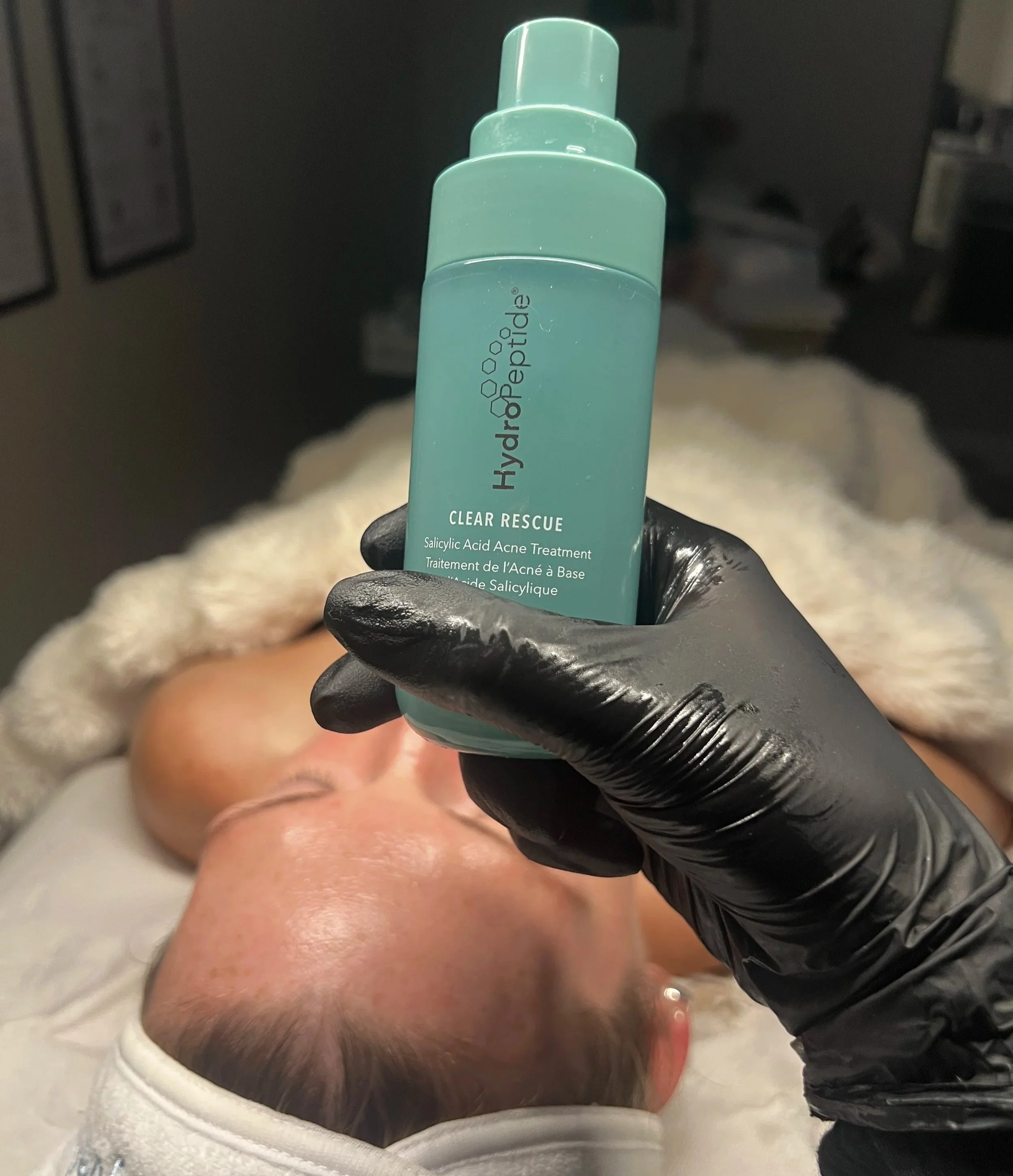
Professional skincare, personalised to you
At Beau.t, products are selected according to your skin, concerns and treatment goals. Professional skincare isn't about using every active ingredient available — it's about choosing what is appropriate for your skin at the right time.
My approach at Beau.t
The more I learn about skin, the less interested I become in the idea of one "perfect" ingredient or one treatment that everybody needs.
Skin is individual.
That's why your treatment at Beau.t begins with your skin, your concerns and your goals — not simply the facial you've seen someone else having on Instagram.
The professional skincare I use during your treatment is selected around what your skin needs, and where appropriate we can also discuss homecare that supports what we're trying to achieve between appointments.
Sometimes that might include peptide-focused skincare.
Sometimes another ingredient or approach may be more appropriate.
And sometimes the best thing we can do for your skin is actually simplify what you're already doing.
Not sure what your skin actually needs?
You don't need to arrive at Beau.t knowing which peptide, serum, active ingredient — or even which facial — you need.
That's what consultation and skin assessment are for.
Together, we can look at your skin, what you're currently using, what you'd like to improve and create an approach that actually makes sense for you.
Healthy skin isn't about using everything. It's about understanding what your skin needs — and being consistent with the right things.
References
van Walraven N, FitzGerald RJ, Danneel H-J, Amigo-Benavent M. Bioactive peptides in cosmetic formulations: Review of current in vitro and ex vivo evidence. Peptides. 2025;193:171440. PubMed
Mortazavi SM, Moghimi HR. Skin permeability, a dismissed necessity for anti-wrinkle peptide performance. International Journal of Cosmetic Science. 2022. PubMed
Errante F, Ledwoń P, Latajka R, Rovero P, Papini AM. Peptides as Active Ingredients: A Challenge for Cosmeceutical Industry. 2020. PubMed
Gorouhi F, Maibach HI. Topical peptides as cosmeceuticals. 2016. PubMed
HydroPeptide. Our Science — Professional Skincare Powered by Peptides. HydroPeptide